
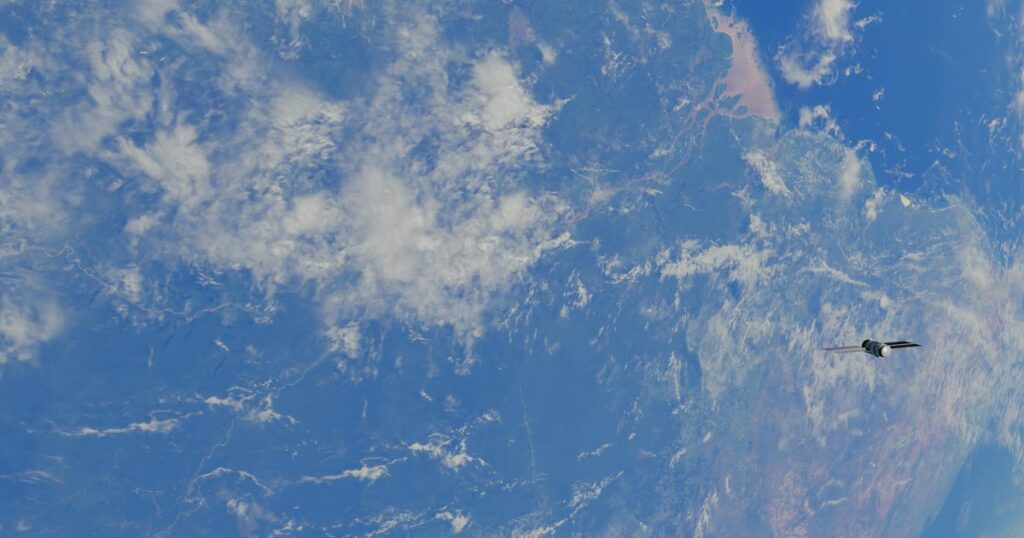
The Artemis II mission is hurtling toward its climax as four astronauts prepare for a treacherous return to Earth. Reid Wiseman, Victor Glover, Christina Koch, and Jeremy Hansen are scheduled to begin re-entry at 7:33 p.m. ET on Friday, with splashdown in the Pacific Ocean off San Diego slated for 8:07 p.m. This moment marks the end of a 10-day journey that pushed human exploration farther from our planet than ever before—reaching an estimated 252,760 miles into space.
That distance equates to roughly 100 trips between New York City and Los Angeles, all confined within Orion’s 330 cubic feet of habitable space. To put it in perspective, that’s about the interior volume of two minivans. The crew’s primary objective has been to gather data through planned tests, evaluating Orion’s performance with humans aboard in deep space. These trials included communication system checks, trajectory adjustments, and the ultimate challenge: a safe atmospheric re-entry and ocean landing.
NASA will broadcast the event live, offering a real-time view of the capsule’s descent. This splashdown represents one of the most hazardous phases of the entire mission, a fact underscored by history. During the uncrewed Artemis I flight in 2022, Orion’s heat shield sustained unexpected damage upon re-entry. The shield, constructed from AVCOAT material, is engineered to ablate slowly, shielding occupants from temperatures nearing 5,000 degrees Fahrenheit as the craft plunges through Earth’s atmosphere. Yet post-flight inspection revealed charring and cracking in areas where it shouldn’t have occurred.
NASA officials have stated that even with such damage, a crew would have returned safely on Artemis I. The agency has since conducted extensive research into the root causes of the heat shield’s degradation. Nevertheless, this component remains a focal point of concern as global audiences await the astronauts’ homecoming.
Artemis II signifies the first human voyage to lunar orbit in over five decades. The mission departed Earth on April 1, quickly encountering minor technical glitches like issues with Microsoft Office software and toilet malfunctions. These mundane setbacks were swiftly eclipsed by the awe-inspiring imagery and data transmitted from the moon’s far side. New photographs from the lunar flyby have already been released, showcasing previously unseen terrain.
The astronauts also engaged in symbolic acts, naming newly observed craters. One was dedicated to mission commander Reid Wiseman’s late wife, Carroll, who passed away from cancer in 2020 at age 46. From their unique vantage point, the crew witnessed a total solar eclipse from just thousands of miles away from the moon—a perspective never before experienced by humans.
“It wasn’t just an eclipse with the Sun hidden behind the Moon,” explained mission specialist Christina Koch. “We could also see earthshine, the Sun’s light reflecting off Earth, wrapping the Moon in a soft, borrowed glow.”
As the live stream continues, all eyes are on the Pacific, where a successful splashdown will validate Orion’s design and pave the way for future lunar landings. The data collected here is crucial for NASA’s ambitions to establish a sustained presence on the moon.