

The landscape of AI compute spending has undergone a seismic shift this week, with five groundbreaking multi-billion-dollar deals setting a new benchmark for frontier-AI infrastructure investment. Anthropic, OpenAI, Google, Amazon, and Mira Murati’s Thinking Machines Lab have collectively committed over $200 billion in infrastructure agreements, shattering previous norms. This surge in spending signifies not just an increase in monetary values but a fundamental transformation in how AI labs align with cloud services. A year ago, commitments ranged from $1 to $5 billion; now they begin at $5 billion and can soar beyond $100 billion. This article will explore the implications of these massive deals, highlighting their impact on the AI industry’s architecture and market dynamics, and discuss how they influence stack-runner architecture decisions.
Context
AI and cloud computing have been intertwined for years, but the scale of the recent deals marks an unprecedented escalation. Previously, AI labs operated within a tier where infrastructure commitments were modest, rarely exceeding a few billion dollars. However, as AI models have grown more complex and computationally demanding, the need for expansive and specialized infrastructure has intensified. The past year has seen significant developments in AI capabilities, driving the demand for more extensive cloud resources. This demand has been further amplified by advancements in AI model training techniques, requiring vast amounts of compute power to develop and deploy cutting-edge models effectively.
The key players in this shift are some of the industry’s most influential entities. Anthropic, a leader in AI safety and research, has spearheaded this new wave with a commitment to spend over $100 billion on AWS infrastructure. This deal is not only a testament to AWS’s dominance in the cloud market but also highlights the strategic importance of securing reliable, scalable compute power. Google’s $40 billion investment in Anthropic, attached to 5 GW of TPU compute, underscores the competitive landscape where tech giants vie for AI supremacy by securing partnerships that enhance their technological edge.
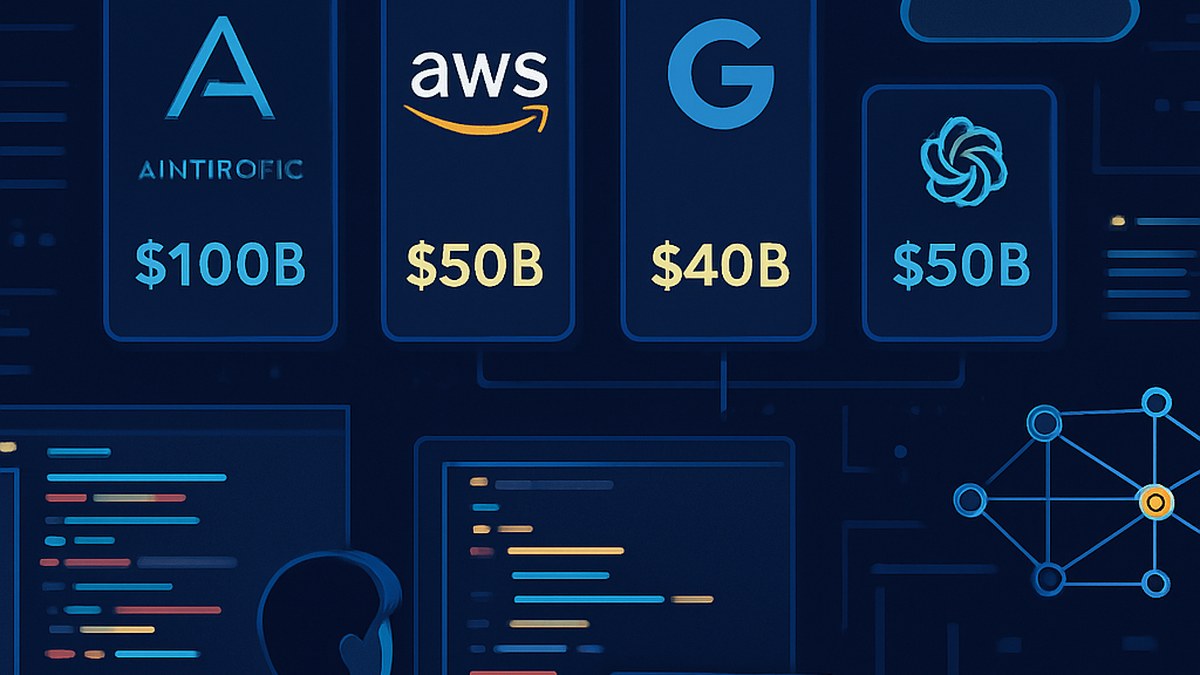
Meanwhile, OpenAI’s $50 billion agreement with Amazon marks a significant departure from its previous exclusive partnership framework with Microsoft. By diversifying its cloud infrastructure partnerships, OpenAI is strategically positioning itself to leverage different technological advantages offered by various cloud providers. Mira Murati’s Thinking Machines Lab’s deal with Google Cloud, involving the latest Nvidia GPU systems, illustrates a broader trend where bespoke, state-of-the-art hardware solutions are increasingly sought after to meet specialized AI research needs. Collectively, these deals reflect an industry where the stakes are higher, and the players are more focused than ever on securing the infrastructure necessary to drive the next wave of AI innovation.
What Happened
Over the past two months, the AI infrastructure landscape has been redefined by a series of high-stakes agreements. Anthropic’s commitment to AWS involves a staggering $100 billion investment over the next decade, focusing on 5 gigawatts of Trainium and Graviton compute. This deal represents a new peak in cloud infrastructure commitments, with Anthropic securing vast computational resources to advance its AI research agenda. Similarly, Google’s partnership with Anthropic, valued at up to $40 billion, includes the deployment of 5 gigawatts of TPU compute, signifying a robust collaboration aimed at enhancing AI capabilities through Google’s tailored hardware solutions.
In a strategic move, OpenAI has inked a $50 billion deal with Amazon, marking a significant shift in its infrastructure strategy. This agreement reflects OpenAI’s need for diverse cloud resources to support its vast array of AI projects and indicates a broader industry trend of seeking multiple cloud partnerships to maximize technological benefits. Amazon’s involvement, aside from its ongoing relationship with Anthropic through a $5 billion additional investment, illustrates its ambition to solidify its position as a leading cloud provider for AI research labs.

Mira Murati’s Thinking Machines Lab has also entered the fray with a multibillion-dollar agreement with Google Cloud. This partnership, centered around the deployment of the latest Nvidia GPU systems, is designed to push the boundaries of AI research. With these agreements in place, the aggregate compute capacity committed exceeds 11 gigawatts, equivalent to the electrical load of a medium-sized US state, highlighting the scale and impact of these deals on the infrastructure landscape.
Why It Matters
The implications of these massive AI infrastructure deals extend far beyond the immediate financial commitments. For the AI industry, this marks a pivotal moment where the ability to access large-scale, specialized compute resources becomes a defining factor for success. With companies committing billions to secure these resources, the competitive landscape is shifting towards a bifurcated model. On one side are the hyperscale players with access to discounted, co-engineered silicon solutions, and on the other are smaller labs facing the challenge of competing at retail prices.
This bifurcation has significant consequences for the industry’s innovation pipeline. The massive investments allow leading AI labs to drive research and development at an unprecedented pace, potentially accelerating breakthroughs in AI capabilities. However, smaller labs may struggle to keep up, lacking the financial means to secure comparable levels of infrastructure. This widening gap could lead to a concentration of AI research and innovation within a few dominant players, potentially stifling diversity in research approaches and solutions.
For consumers and businesses leveraging AI technologies, these infrastructure shifts could result in more robust and capable AI solutions. As leading labs advance their capabilities, the potential for more sophisticated and efficient AI applications grows. However, this also raises questions about access and equity in AI technology distribution. As larger players consolidate their hold on cutting-edge resources, ensuring that these advancements benefit a broad swath of users rather than a select few becomes a crucial consideration for industry stakeholders.
How We Approached This
In crafting this article, we drew from a diverse array of sources, including official announcements from the companies involved, industry analysis reports, and insights from leading experts in AI infrastructure. Our focus was to provide a comprehensive overview of the recent deals while highlighting the broader implications for the AI industry and beyond. We prioritized clarity and precision, ensuring that the information presented accurately reflects the current state and future trajectory of AI compute spending.
Our editorial lens at Stack Runner emphasizes the practical implications for developers and IT decision-makers. We aimed to elucidate how these developments affect stack-runner architecture decisions and the competitive landscape. By concentrating on the impact of these deals on infrastructure availability and pricing, we sought to provide our readers with actionable insights that inform their strategic planning and technology investments.
Frequently Asked Questions
What is the significance of the $100 billion deal between Anthropic and AWS?
The $100 billion deal between Anthropic and AWS marks a new benchmark in AI infrastructure investment, highlighting the strategic importance of securing large-scale, specialized compute resources. This partnership underscores AWS’s position as a dominant player in the cloud market and reflects the growing demand for advanced infrastructure to support cutting-edge AI research and development.
How does OpenAI’s deal with Amazon differ from its previous partnership with Microsoft?
OpenAI’s $50 billion agreement with Amazon represents a strategic diversification of its cloud infrastructure partnerships. Unlike its previous exclusive framework with Microsoft, this deal enables OpenAI to leverage Amazon’s unique technological offerings, potentially enhancing its AI capabilities. This move reflects a broader industry trend of seeking multiple partnerships to maximize technological advantages.
What are the potential industry-wide impacts of these AI infrastructure deals?
The industry-wide impacts include a shift towards a bifurcated competitive landscape where hyperscale players dominate access to discounted, co-engineered silicon solutions. This could accelerate AI innovation among leading labs while posing challenges for smaller players. Additionally, these deals may lead to more sophisticated AI applications for businesses and consumers, though access and equity considerations remain crucial as larger players consolidate resources.
As the AI infrastructure landscape continues to evolve, these recent deals signal a transformative period for the industry. With over $200 billion in commitments, the dynamics of AI research and cloud computing partnerships have fundamentally changed. For developers and IT decision-makers, understanding these shifts is crucial for navigating the new architecture and competitive realities. The ability to harness these advanced resources could dictate the pace of innovation and set the stage for the next wave of AI advancements.